
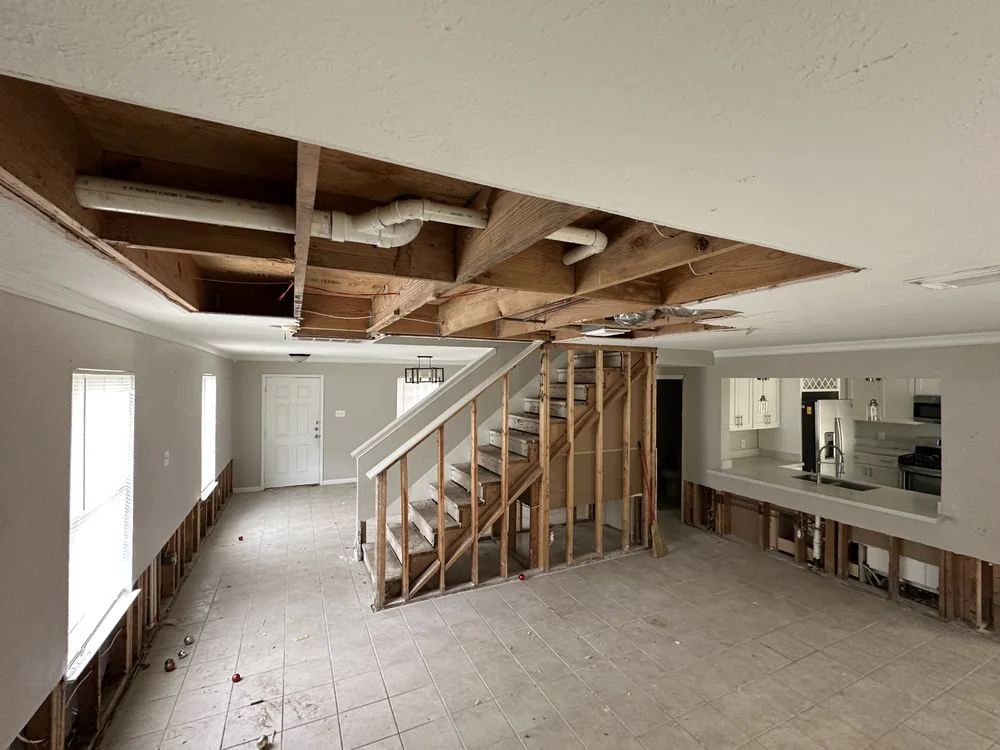

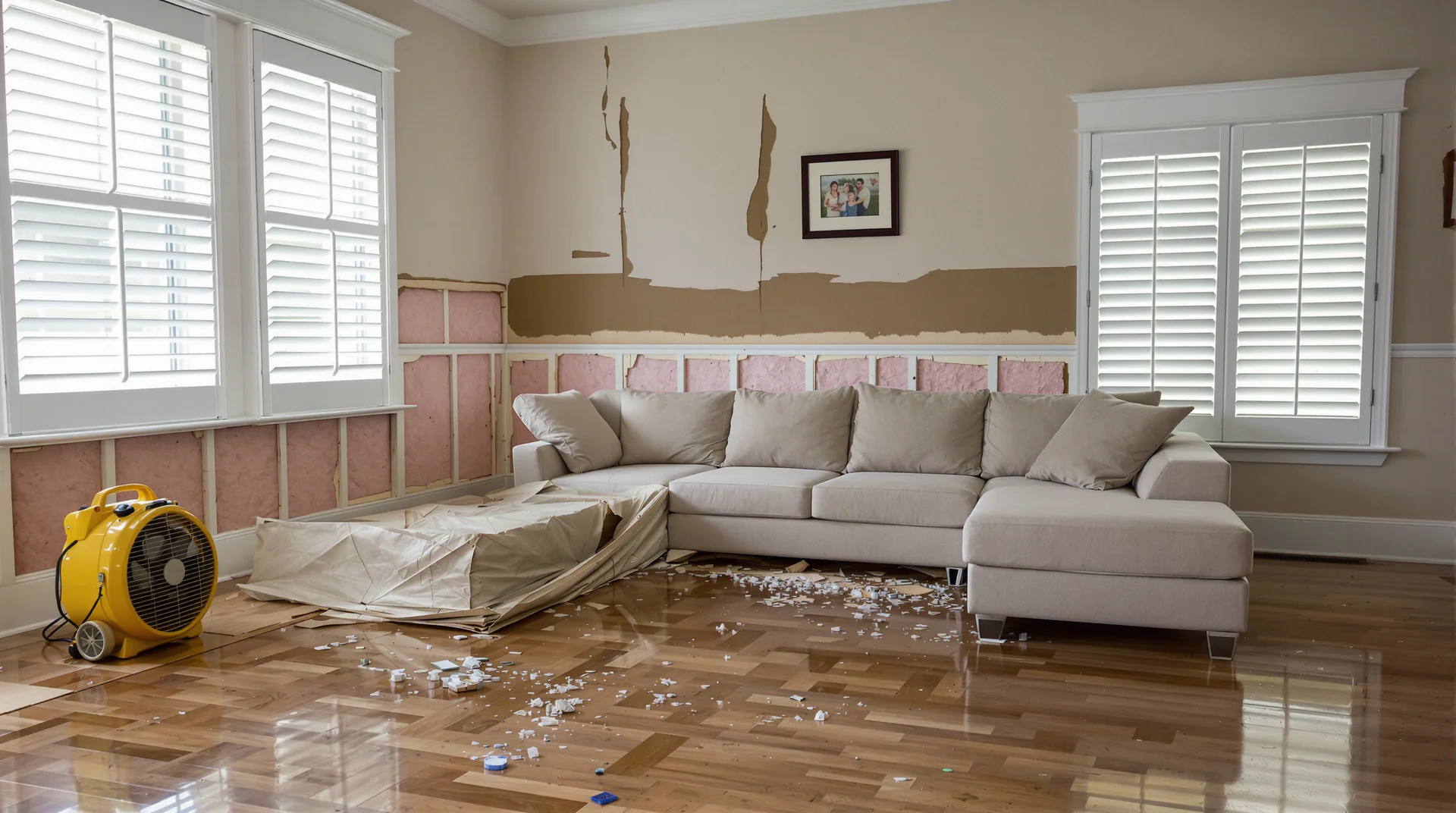
The first 48 hours after a water loss decide the outcome. Wet drywall and insulation grow mold by hour 72. Subfloors warp permanently once moisture migrates beyond 28 percent. In Houston the problem compounds — Greater Katy sits on expansive clay soils that move with moisture, and slow slab leaks under that movement cause more long-term loss than the burst pipe upstairs. Acting fast is the cheapest version of restoration; waiting is the most expensive.
Our process: extract standing water with high-capacity portable extractors, place dehumidifiers and air movers sized to the affected volume per IICRC S500, monitor daily moisture readings to confirm drying targets are met, and demo only what cannot be saved. We document everything for your insurance carrier in the format their adjuster’s software expects — moisture maps, photographs at every stage, and a final dry-out certification.
Category and Class: the two words that decide your whole job
Every water loss gets two labels under IICRC S500, and together they determine how long the job runs, what has to come out, and what your carrier will be looking at.
Category describes how contaminated the water is.
- Category 1 is clean water from a sanitary source: a supply line, a water heater, a tub overflow with nothing in it. Most residential losses start here.
- Category 2 is water with meaningful contamination: dishwasher or washing machine discharge, toilet overflow with urine but no solids, or Category 1 water that has been sitting long enough to degrade. Clean water does not stay clean. It steps down over hours and days.
- Category 3 is grossly contaminated: sewage, rising surface water, or any water carrying pathogens. Porous materials that were contacted come out rather than get dried. See sewage cleanup.
Class describes how much water the structure absorbed and how hard it will be to dry, running from Class 1 (minimal absorption, part of one room) to Class 4 (deeply bound moisture in materials like hardwood, plaster, and concrete that need specialty drying).
The practical takeaway: the same volume of water can be a three-day job or a three-week job depending on what it landed on and how long it sat.
How long does water damage restoration take?
A typical Class 2 loss dries in three to five days. That is drying time, not project time. Reconstruction runs separately afterward and depends on scope, materials, and how fast your carrier approves.
The variable that moves the schedule most is not our equipment. It is how long the water sat before anyone called. Water that has been in a wall cavity for a week is a materially different job from the same water caught in an hour.
Do I have to file a claim?
That is your call, and it is worth understanding before you decide. Water damage that originates inside the house, meaning a burst supply line, a failed water heater, an overflowing appliance, or an AC condensate backup, is a sudden and accidental loss and is the standard covered peril under a Texas homeowners policy. Water that rises in from outside is flood, which homeowners policies exclude.
Nearly every policy also requires you to take reasonable steps to prevent further damage, so starting mitigation protects the claim rather than jeopardizing it. Our insurance claims walkthrough covers the Texas Insurance Code Chapter 542 prompt-pay deadlines, and the West Houston Homeowner’s Guide goes into actual cash value versus replacement cost and recoverable depreciation in full.
Why box fans do not work
The single most common thing we get called to fix is a house someone already tried to dry. Air movement without dehumidification does not remove water from a building. It evaporates it off surfaces and pushes that moisture into wall cavities, framing, and adjacent rooms, where it does more damage than it would have done sitting still.
Drying requires both: air movers to release bound moisture, and dehumidifiers sized to the affected volume to pull that moisture out of the air and out of the structure. Without the second half, you are relocating the problem.
Where we work
Dispatched from our Katy staging area, 24/7, across Katy, Fulshear, Cinco Ranch, Richmond, Sugar Land, Cypress, and Houston.