

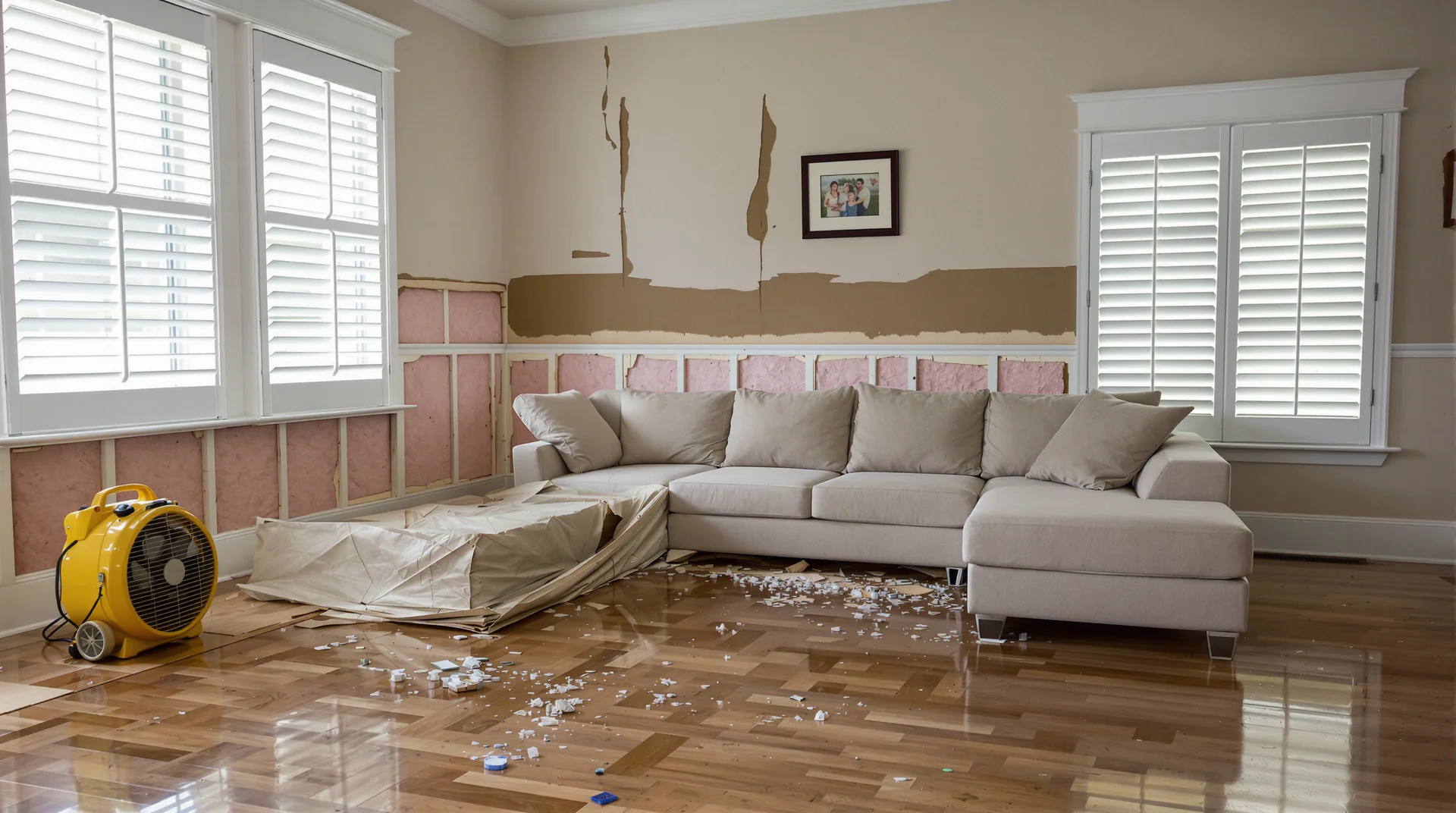
Fulshear is the fastest-growing place we serve, and that changes what breaks. The Census Bureau ranked Fulshear the second fastest-growing city in the United States in its Vintage 2025 estimates, with the population up 21 percent between July 2024 and July 2025 against a 2020 count of 16,856 residents. A city that grows that fast is a city where most of the housing stock is new. New houses fail differently than old ones, and the insurance question that follows is different too.
What actually causes water damage in Fulshear homes
In older Houston-area housing stock, the usual suspects are corroded galvanized supply lines, cast-iron drain failures, and roofs at the end of their service life. Fulshear has comparatively little of that. What we get called out for here is:
- Supply-line and fitting failures in nearly new homes. A PEX line, a push-fit connector, or a braided washing-machine hose lets go in a house that is three years old and looks perfect. These are the calls that surprise homeowners most, because nothing about the house feels old enough to fail.
- Freeze damage. Fulshear sits far enough west that hose bibs and attic runs above unconditioned garage space take the brunt of a January freeze. The February 2021 storm is the reference event, but a hard freeze does this on a smaller scale most winters.
- AC condensate backups. A clogged condensate line during a Houston summer dumps weeks of water into ceiling drywall before anyone notices a stain. Tightly built newer homes hide this longer, not less.
- Storm-driven roof leaks, particularly after spring hail along the Westpark corridor.
- Slab leaks from settling on the expansive clay soils common across Fort Bend County.
Is a burst pipe the builder’s problem or my insurance’s problem?
This is the question we get asked most in Fulshear, and it deserves a straight answer, because the honest one has two parts.
Part one: who might owe you. Most Texas production builders provide a limited warranty on the 1-2-10 pattern. One year on workmanship and materials, two years on the major systems (plumbing, electrical, heating and air conditioning), and ten years on major structural components. Since House Bill 2023 took effect on June 9, 2023, a builder who instead provides a 1-2-6 warranty gets a shorter six-year statute of repose on latent structural defects. Where no such warranty is provided, the ten-year period still applies. A supply-line failure is a plumbing-systems issue, which puts it in the two-year tier for most homeowners.
Your warranty is a contract, not a statute. The tiers above are the common convention, not a guarantee about your house. The document that governs is the warranty booklet you received at closing, and the date that matters is your closing date, not the age of your neighborhood.
Part two: what to do about it right now. Whatever the warranty says, it does not dry your house. A builder warranty claim moves in days. Water moves in hours, and Category 1 clean water degrades toward Category 2 the longer it sits in building materials. Nearly every homeowners policy also requires you to take reasonable steps to prevent further damage, so waiting on a warranty determination can itself put your insurance claim at risk.
The sequence that protects you is: stop the water, document everything before anything is moved or removed, start mitigation, and pursue the warranty and the insurance claim in parallel from there. Mitigation cost is generally recoverable from whichever party ends up responsible. Delay is recoverable from nobody.
Which Fulshear neighborhoods are still inside the warranty window?
Go by your closing date rather than by your subdivision, because the master-planned communities out here span very different build eras.
Cross Creek Ranch is the useful worked example. It is a 3,200-acre Johnson Development community whose first homes sold in 2008 and which is now built out, so the large majority of its roughly 3,700 households are well past the two-year systems tier and, depending on closing date, may be at or past the structural tier as well. Its sister community Cross Creek West is still selling, which puts many of those homes squarely inside the two-year plumbing window today.
Fulbrook on Fulshear Creek, Tamarron, Polo Ranch, and Jordan Ranch each contain sections closed in different years. Two houses on the same street can sit on opposite sides of a warranty tier. Pull your closing documents before you assume either way.
What we have actually seen out here
We have completed 150 residential water damage jobs since 2021 across Katy, Fulshear, Cinco Ranch, Cross Creek Ranch, Firethorne, and Richmond. One Fulshear file is worth describing in full, because it is representative.
A 2,800-square-foot single-story in Cross Creek Ranch, built in 2014. A PEX supply line in the attic above the garage burst during a January freeze and ran for roughly eight hours before it was found. Total recovery on the claim came to $46,700. The detail that made the difference was not anything we did during drying: it was that the homeowner had real-estate photos of the kitchen from two years earlier, which made the depreciation negotiation on the cabinets straightforward instead of adversarial.
That is the practical lesson for every Fulshear homeowner reading this. Photograph your finished spaces now, while they are dry, and keep the files somewhere that is not inside the house.
Is Fulshear in a flood zone, and would my policy cover it?
Flood zone designations in Fulshear vary lot by lot, not neighborhood by neighborhood, so the only reliable answer for your address is the current FEMA flood map for your specific parcel. Proximity to the western reach of the Brazos River and to the agricultural drainage network west of town matters, but so does where your lot sits relative to it.
The coverage distinction matters more than the zone, and it is where we see the most expensive misunderstandings:
- Water that originates inside your house (a burst supply line, a failed water heater, an overflowing appliance, an AC condensate backup) is a sudden and accidental loss. This is the standard covered peril under a Texas homeowners policy, and it is what causes the clear majority of the Fulshear losses we respond to.
- Surface water rising from outside and entering the structure is flood. Homeowners policies exclude it. Covering it requires a separate NFIP or private flood policy.
A great many Fulshear homeowners assume a water loss is not covered because they do not carry flood insurance. If a pipe failed inside your walls, flood insurance was never the relevant policy. Read our insurance claims walkthrough before you decide not to file. The West Houston Homeowner’s Guide to Water Damage and Insurance Claims covers the Texas Insurance Code Chapter 542 prompt-pay deadlines, actual cash value versus replacement cost, and recoverable depreciation in full.
What to do in the first hour
- Shut the water off at the main. Everything else is secondary to stopping the source.
- Photograph and video everything before you move anything. Wide shots of each affected room, then close-ups of the failure point. This is the single highest-value thing a homeowner does, and it takes four minutes.
- Call us. Mitigation starts the clock in the right direction and satisfies your policy’s duty to prevent further damage.
- Then open the claim with your carrier. Chapter 542 deadlines begin running from notice, so the sooner you give notice, the sooner the statutory clock is working for you.
- Do not sign an Assignment of Benefits. We do not ask for one, and you should be cautious about anyone who does.
Do not run your own box fans across standing water and call it dry. Air movement without dehumidification relocates moisture into wall cavities and framing rather than removing it from the building, and it is the most common reason we get called back to a house someone already tried to dry.
Getting to Fulshear
We stage out of Katy, so Fulshear is one of the closer runs we make. The truck rolls within five minutes of the call, and typical response across the service area is 25 to 45 minutes, with Fulshear at the fast end of that range. The phone is answered around the clock by the crew on rotating on-call shifts rather than by an answering service, and the crew is bilingual in English and Spanish.
We are IICRC certified in Water Damage Restoration and Applied Structural Drying, we bill insurance carriers directly and write estimates in Xactimate, and the same crew that performs the demolition handles the rebuild. Estimates are free.
For the service-level detail on extraction, structural drying, and reconstruction in Fulshear, see water damage restoration in Fulshear.